
Peer Review Guidelines
This journal follows a double-blind peer review model. In line with the aims and mission of the journal, papers are normally peer reviewed by two independent academic experts, and additional or supplementary reviews by experts from the policy community may be sought to ensure high-quality, impactful publications that are both academically rigorous and policy relevant.
Review Process
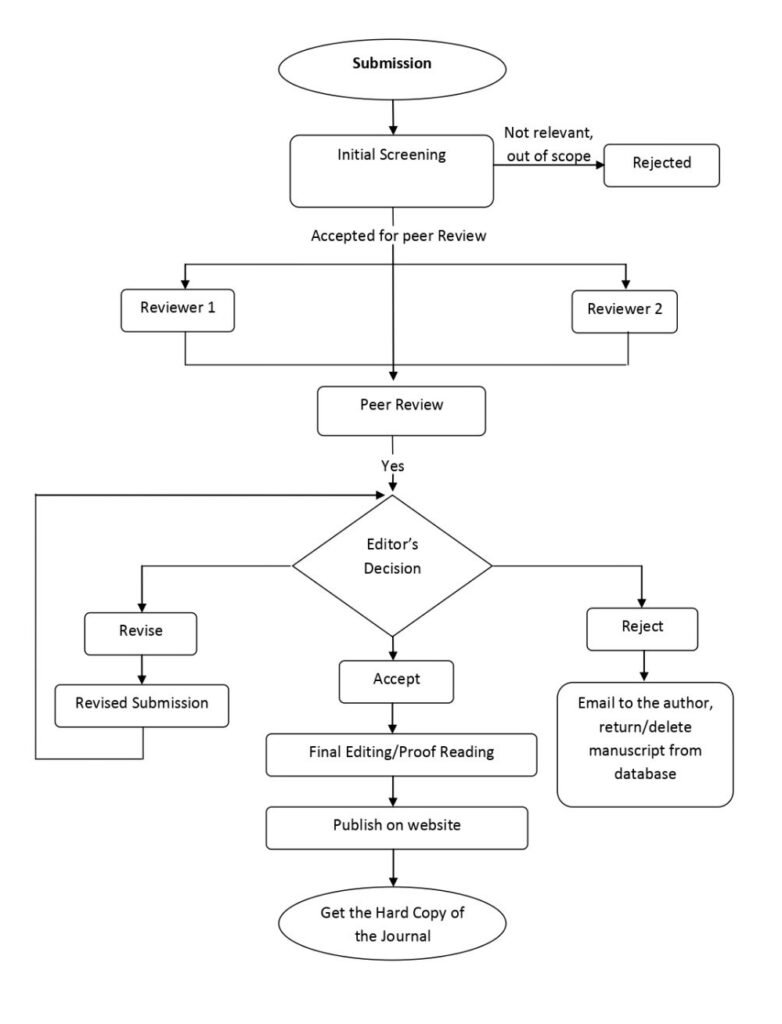
When a manuscript is submitted to IJIRG journal it passes through a number of steps:
(1) First, the manuscript is assessed by the Editorial Office to check ifthe manuscript adheres to the journal guidelines. If there are any problems the manuscript will be unsubmitted and returned to the author to be corrected.
(2) The manuscript is then passed to a Senior Editor who checks if the manuscript fits within the journal’s scope and is of interest to the broad readership of the journal. The Editor will either reject the manuscript or pass it onto an Associate Editor.
(3) The Associate Editor checks that the research is scientifically rigorous and that the manuscript is of interest to the specific subject area. The Associate Editor then makes a recommendation to the Editor to reject the manuscript, selects appropriate reviewers, or occasionally will ask the author to make revisions before sending it for review.
(4) In general, two reviewers who are having expertise in respective subjects are sought who analyze the work submitted in the manuscript in detail and write a report.
(5) The Associate Editor after evaluating the comment/ remarks of the reviewers writes a recommendation to the Editor. Associate Editors are encouraged to make a recommendation within 5 days.
(6) The Editor evaluates the Associate Editors recommendation and the reviewer reports and makes a decision. Once a recommendation has been received Editors aim to make a decision on a manuscript within 7 days.
The total review process is generally expected to take 50 days. The dedicated Editorial Office staff tries to minimize delays and is on hand to answer any queries.
Criteria for Qualification or Rejection of Scientific Articles
Purpose: Scientific articles should be evaluated systematically for relevance, originality, methodological soundness, ethical compliance, scientific significance, and quality of presentation.
A. Criteria for Qualification / Acceptance
- Falls within the scope of the journal and addresses a relevant scientific or interdisciplinary topic.
- Presents a clear research problem, objective, research question, or hypothesis.
- Demonstrates originality and scientific novelty.
- Uses an appropriate and clearly described research methodology.
- Presents valid, reliable, and adequately analyzed data.
- Reports results clearly and provides an appropriate interpretation and discussion.
- Draws conclusions that are supported by the results and available evidence.
- Uses relevant, recent, and properly cited references.
- Complies with applicable research and publication ethics, including ethical approval and informed consent where required.
- Is written in clear, coherent, and scientifically appropriate language.
- Follows the journal’s prescribed format, structure, and submission guidelines.
- Contains no significant plagiarism, duplicate publication, fabrication, or falsification.
- Properly declares funding sources, conflicts of interest, and author contributions where applicable.
- Makes a meaningful contribution to existing scientific knowledge.
B. Criteria for Minor/Major Revision
- Minor language, grammar, or formatting problems.
- Insufficient explanation or documentation of the methodology.
- Incomplete presentation of data or supporting information.
- Weak literature review or inadequate/relevant referencing that can be improved.
- Statistical or analytical issues that can reasonably be corrected.
- Discussion requires strengthening or better engagement with previous studies.
- Conclusions require better alignment with the findings.
- Reviewer or editor concerns can be addressed without fundamentally changing the study.
C. Criteria for Rejection
- The article is outside the scope of the journal.
- The work lacks originality or does not provide a meaningful scientific contribution.
- There are serious methodological flaws that cannot be adequately corrected.
- Data are insufficient, unreliable, fabricated, falsified, or improperly analyzed.
- The conclusions are substantially unsupported by the results or evidence.
- The manuscript contains substantial plagiarism or inappropriate text reuse.
- The work has been published previously or submitted simultaneously elsewhere contrary to journal policy.
- Essential ethical requirements have not been met or cannot be satisfactorily demonstrated.
- There are serious problems with citations, attribution, or use of sources.
- The manuscript is presented in a form that prevents meaningful scientific evaluation despite reasonable opportunity for improvement.
- Essential journal submission requirements are not met.
- Major reviewer/editorial concerns remain unresolved after an adequate revision opportunity.
- Undisclosed conflicts of interest or other integrity concerns compromise the credibility of the research.
D. Recommended Editorial Evaluation Matrix
Evaluation Criterion | Importance | Decision Indicator |
Relevance to journal scope | Essential | Must satisfy |
Originality / Novelty | Very High | Strongly required |
Scientific significance | Very High | Strong contribution expected |
Methodology | Very High | Must be scientifically sound |
Data quality and analysis | Very High | Must be reliable and appropriate |
Results and discussion | High | Must be clear and convincing |
Conclusions | High | Must follow from evidence |
References | Moderate–High | Relevant and adequate |
Ethical compliance | Essential | Must satisfy |
Research and publication integrity | Essential | No serious misconduct |
Language and presentation | Moderate | Must be understandable |
Compliance with journal guidelines | Moderate–High | Required |